Stargaze
A star, galaxy, and quasar classifier built on five brightness measurements that stays accurate on noisy or incomplete data and says “not sure” when it can’t be trusted.
Data Scientist and ML Engineer, Stargaze, 2026.
The idea
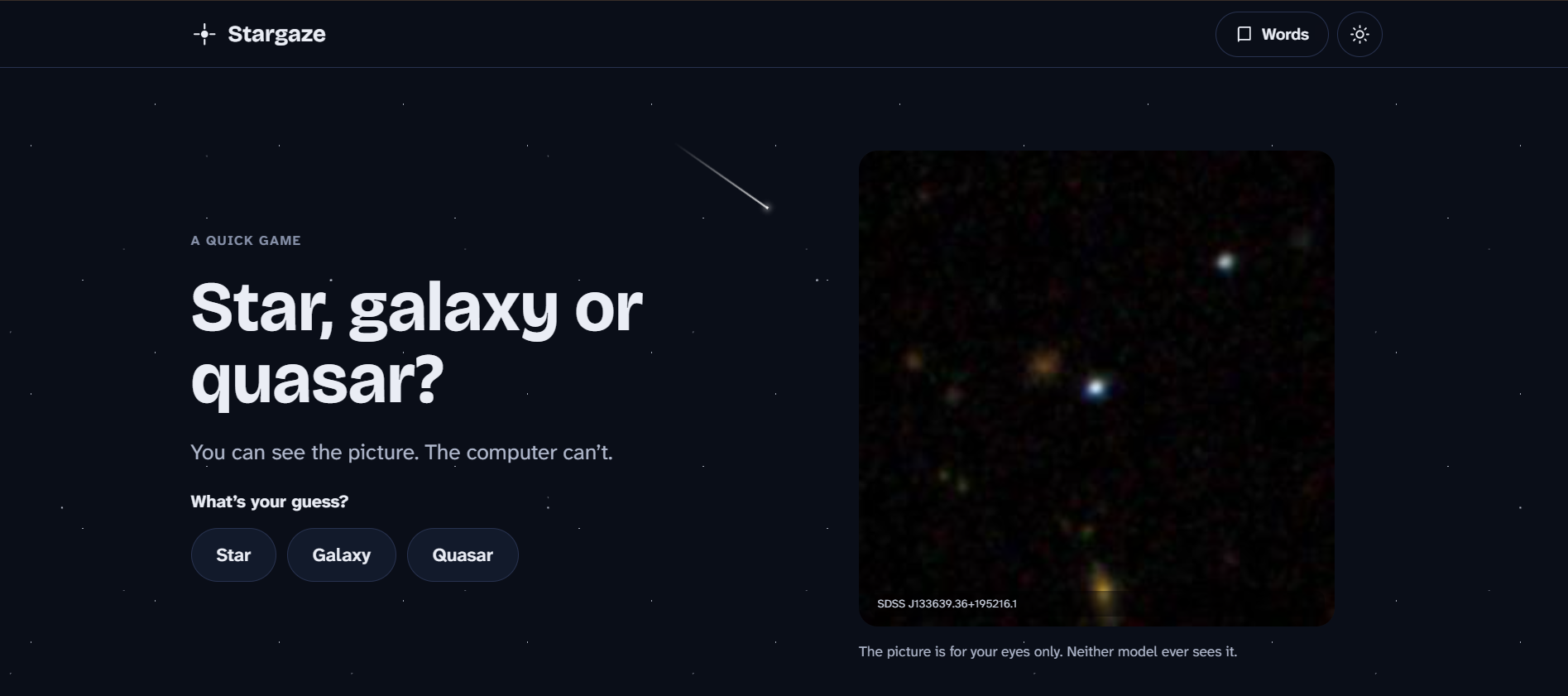
Ordinary classifiers keep answering confidently even when their input is noisy or incomplete. Stargaze classifies stars, galaxies, and quasars from five brightness measurements, and says “not sure” when it can’t be trusted.
What I did
- Built a pipeline on 283,108 SDSS DR17 objects, cleaned through bronze, silver, and gold layers
- Trained a gradient boosting model (scikit-learn) on clean data plus damaged copies with added noise, missing colors, and impossible values
- Added a trust layer with calibration, an Isolation Forest for unusual inputs, and a confidence threshold that triggers “not sure”
- Tested once on 37,775 held-out objects, plus a cross-survey check on DESI data
- Shipped a FastAPI endpoint, a Streamlit app, and a React and Tailwind demo site
Result
With 2 of 5 colors missing, Stargaze scored 86 vs 35 for an ordinary model, and it was right about 92% of the time on the objects it chose to answer.